
Large Call to Action Headline
FOR NRI FAMILIES
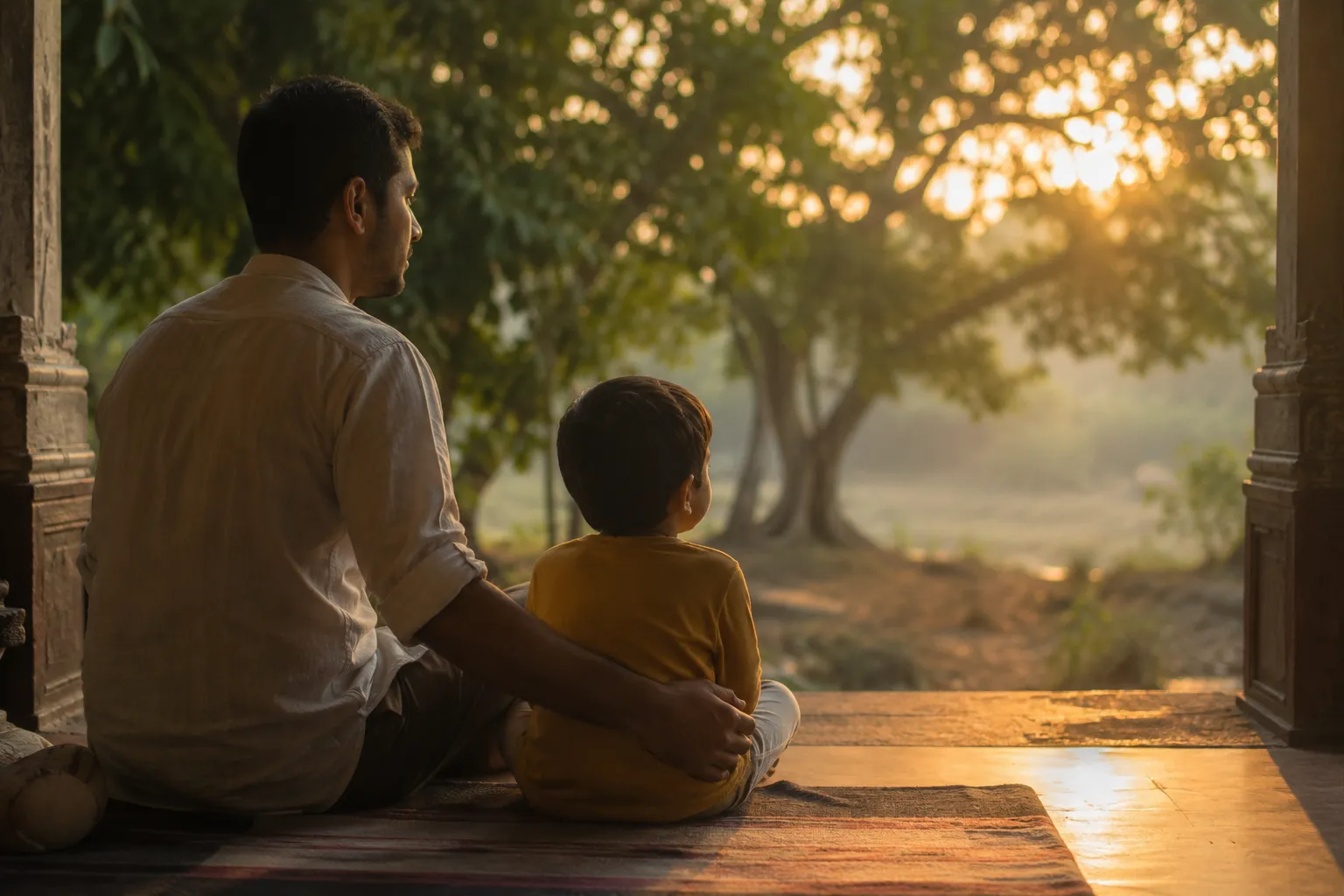
He asked once why we do it. I said because we do. He never asked again.
That was the whole conversation, and it did not feel like a loss at the time. It was the moment the tradition stopped being something he could use, and became something he tolerates, politely, for you.
FOUR THINGS YOU ARE WATCHING
Read each one slowly. One of them is the reason you are here.
01
The Answer That Closed It
You were not being lazy. You answered the way it was answered to you, and on you it worked, because everything around you agreed with it. Nothing around him agrees with it. So the answer arrived as an instruction, he followed it, and he stopped asking.
02
The Call With His Grandmother
She speaks to him in the language. He answers in English. Both of them treat this as fine, and for now it is. What is actually happening is that the one person who could have explained any of it to him can no longer reach him, and that window is not open indefinitely.
03
You Were Handed The Same Thing
Nobody sat you down and explained it to you either. You absorbed it from a street, a grandmother, a temple on the corner and forty people who all did the same things. It transmitted without anyone having to defend it. You are not the first generation that does not know why. You are the first one who has to say it out loud.
04
Nothing Seems Wrong
No crisis. No rebellion. Nothing you could name to a friend. Just a sense that something has not been passed on, and that you will find out for certain in about six years, when it is far harder to do anything about.
THE PART NOBODY EXPECTS
Five hundred young Hindus in Britain were asked directly. This is not a generation walking away.
93%
Are happy to be Hindu
Not embarrassed by it. Not distancing themselves from it. Not one sign of the rejection you have been quietly bracing for.
90%
Will teach it to their own children
The intention to pass it on is already there, fully formed, before anybody asked them to have it.
88%
Say it is relevant today
They are not treating it as a museum piece. They believe it applies to the life they are actually living.
1 in 3
Could not say what the soul is
That is among the ones who called themselves happy and religious. On the reasons behind the rituals, and on what they contain, they said plainly that they did not understand them, and that they wanted to. Oxford Centre for Hindu Studies, 2001.
IT IS NOT YOUR CITY
The same gap turns up under opposite conditions, at home as much as abroad, which is how you know it is not a mistake you made.
Dubai
Maximum exposure
Indian school, Indian curriculum, Indian friends, three hours from home. The children raised there still describe themselves as in between. More culture did not close it.
Singapore
The state taught the language
Tamil is a mother tongue subject in school, by law. The shift to English happened anyway. What the research points at instead is the home, the parents own attitude, and whether the practice carries a reason.
Durban
Five generations in
The languages are largely gone and most are monolingual now. The Hindu identity is still there, rebuilt in a new form. Which means the language was never the thing carrying it.
Home
India not spared
Living in India closes nothing. A 2025 survey of 7,382 people across eighteen states found urban youth practising at least as much as everybody else, with 39 per cent at a katha or a bhajan every month. What no survey has ever asked them is why. Attendance is the one thing anyone measures, and attendance was never the thing in question.
Trinidad
It began this way
No priests came on the ships. The indentured built the ritual forms themselves, out of memory, and handed them to their children as authoritative, because by then there was no one left who could say where they had come from. A hundred and fifty years on that community is still practising. The split between a practice and its reasoning is not modern decay. It is how this has usually travelled.
Everywhere
And nobody has studied it
The accounts coming back from Nairobi, Kampala, London and Toronto are the same, and no one has bothered to research them. The surface changes in every country: the citizenship, the schooling, the language, whether the child will ever live there. The distance between what is practised and what can be explained does not change anywhere.
THE NEURO-SCIENCE BEHIND

The Clinical Science Behind Your Nervous System
Children Model Parents Nervous System
WHY IT STARTS WITH YOU
You cannot hand him a reasoning you have not rebuilt yourself.
A child does not absorb what he is told. He absorbs what he reads off you and judges to be true, and he starts reading at about seven. That is the entire mechanism, and it is why nothing moves by sending him somewhere on a Sunday. There is a reasoning underneath all of it. It is older than the practice, and it was set down as a manual for deciding under pressure, not as devotion. It is the Gita, and most people raised inside it have never once been shown it that way.
YOUR FIRST STEP
Take the self-audit. Then hand it to your child.
A short, honest audit of where your own reasoning breaks, taken alone, answered truthfully. What you do with the result afterwards is the part your child actually inherits.
Ganga Narayan Das
Neuroscience × Bhagavad Gita. A protocol that recalibrates the executive, trains the educator, and installs coherence in the child, before the pressure arrives.
© 2026 Ganga Narayan Das · Sthira · The Unshakeable Generation
Wisdom is not inherited. It is applied.